Chakra + InfraGraph Ecosystem
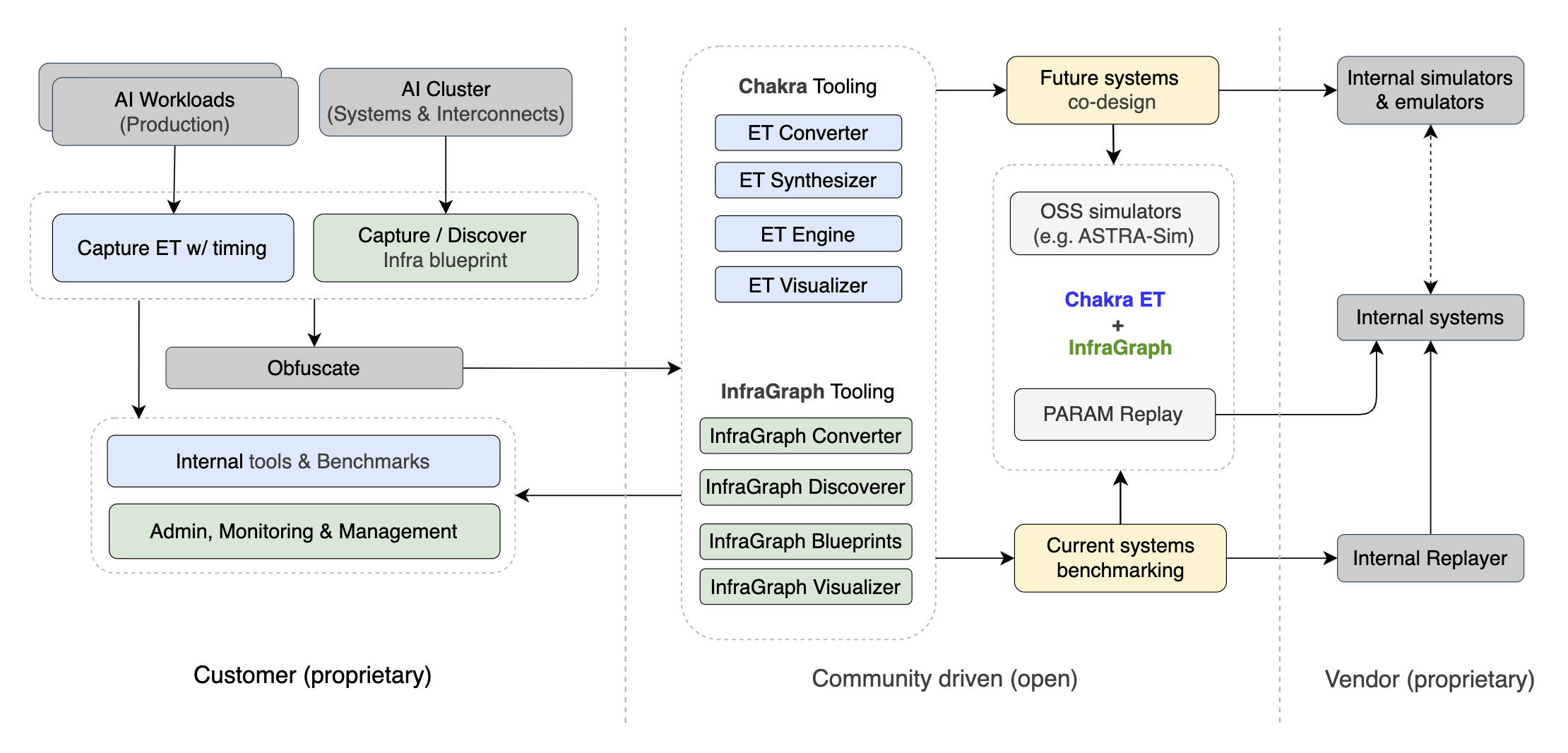
MLCommons Chakra represents the details of any AI workload by capturing Execution Traces (ET) - graphs of operators, tensors, dependencies, and timing.
InfraGraph represents the underlying systems and infrastructure used for AI training or inference - hosts, NICs, xPUs/accelerators, interconnects, and topologies - using programmatic system blueprints.
Together, Chakra + InfraGraph let you pair workload traces with infrastructure blueprints to analyze current systems and co‑design future ones, while safely sharing artifacts across teams and partners.
InfraGraph Helper Tools
Like Chakra, InfraGraph also proposes a set of helper tools that can help users while working with InfraGraph.
1. Converters
Many open‑source and commercial tools model systems using their own schemas (e.g., lspci, lshw, OpenMPI tools, NetBox, etc.). InfraGraph is adding translators to ensure interoperability - import from (and export to) these formats without rewriting everything.
2. Discoverers
Discovery has two aspects:
- Configuration discovery - capture the attributes of each node/host device.
- Topology discovery - map interconnections across a distributed system.
InfraGraph aims to support dynamic discovery so infrastructure details can be captured automatically and kept up to date.
3. Blueprints
We’re building blueprint templates for commonly used systems in AI data centers (AI DCs):
- Devices - hosts from NVIDIA, Meta, Dell, HPE, etc. vendors, devices like NICs, XPUs/accelerators, and other components.
- Fabrics/topologies - standard definitions such as Clos and Dragonfly.
These blueprints help researchers quickly assemble infrastructure definitions for experimentation and serve as reference models when building new designs.
4. Visualizers
Graphical views make it easier to spot design issues:
- Drill‑down to component‑level details.
- Zoom‑out to high‑level system connectivity.
Visualizers assist developers in understanding structure, bottlenecks, and correctness.
These helper tools are accessible through the InfraGraph CLI.
Note: Some of these tools are work-in-progress and we invite contributions from the community.
Privacy & Obfuscation
InfraGraph, like Chakra, supports selective disclosure and obfuscation so you can safely share only high‑level infrastructure definitions.
Private annotations:
One can attach additional details to infrastructure elements or devices, links, fabrics, racks/pods - as annotations (structured fields or free text). These may include vendor‑specific information, firmware/driver versions, internal asset tags, SKUs, or configuration notes.
- Annotations can be kept private for internal tools and workflows.
- Private annotations can be excluded or obfuscated when exporting or sharing the InfraGraph outside your organization.
Safe sharing:
When publishing to vendors or the open‑source community, you decide which fields remain, which are transformed, and which are removed - preserving the high‑level system definition while protecting sensitive details about the network and device configurations.
Sharing & Interoperability
InfraGraph definitions can be shared with vendors and the open‑source community and used with a variety of analyzers, simulators, or emulators (open or commercial). The emphasis is on:
- Portability: consistent, schema‑driven artifacts.
- Compatibility: converters for common ecosystem tools.
- Safety: optional obfuscation to protect IP while enabling collaboration.
- Composability: components or devices defined separately can be reused across systems or inserted into different topologies, making it easy to mix, match, and assemble infrastructure from modular parts.